

Bioavailability: why the form decides how much arrives
Two supplements can list the same milligrams on the label and end up doing very different things. The number on the front tells you what went into the capsule. It does not tell you how much of it makes it through your stomach, through the gut wall and into your blood.
That share has a name: bioavailability. It is the reason a cheap ingredient can be an expensive mistake — and the reason we pay more for raw materials than we would have to.

What bioavailability actually means
Bioavailability is the proportion of a nutrient that reaches your bloodstream in a usable form. Two things decide it: whether the substance dissolves at all, and whether your body can carry it across the gut wall.
Both depend on the chemical form. Not on the dose printed on the box.
Magnesium: the clearest example
Magnesium is the most supplemented mineral in Germany — and the one most often wasted. Most products use magnesium oxide, because it is cheap and because it carries a lot of magnesium per gram, which makes the label look impressive. The catch: oxide has to dissolve in stomach acid first, and it does so badly.
In a double-blind crossover trial on the raw material, four magnesium forms were compared at the same dose. Sucrosomial® magnesium — a mineral core inside a protective shell of sucrose esters and phospholipids — led in all three measures: in the blood, inside the cells, and in total magnesium absorbed. Bisglycinate, widely regarded as one of the good forms, showed no rise inside the cells at all.¹
The practical consequence: a smaller dose of a well-absorbed form can deliver more usable magnesium than a large dose of the cheap one.
What the delivery format changes. The protective layer is designed not to dissolve in stomach acid and to open farther along in the digestive tract. This mechanism alone does not prove better tolerance or a clinical benefit of the finished product.
Keratin: why molecule size decides
Hair is largely keratin, so keratin in a capsule sounds logical. The problem is that intact keratin is a large, tough protein — your gut cannot do much with it.
The keratin we use (Kera-Diet®) is hydrolysed until every molecule is below 800 Dalton and more than 83 % of it consists of free amino acids. That is the state in which the gut wall lets it through. In a randomised, placebo-controlled trial at our dose of 500 mg per day, hair gloss rose by 42 % over 90 days.²
Resveratrol and quercetin: barely soluble on their own
Some of the most interesting longevity compounds share a weakness: they hardly dissolve in water, so very little of a standard extract ever reaches the blood.
Two established answers are a liposome — the compound wrapped in a fat layer — and a phytosome, where it is bound to phospholipids. In pharmacokinetic studies from the raw-material manufacturers, liposomal resveratrol (LipoAvail®) reached 14 times the plasma level of a standard extract, and quercetin phytosome (Quercefit®) 20 times the absorption of standard quercetin.³ ⁴
What to look for on a label
Form beats milligrams
| Nutrient | Well absorbed | Common but weak |
|---|---|---|
| Magnesium | Sucrosomial®, bisglycinate | Oxide on its own |
| Keratin | Hydrolysed, under 800 Dalton | Intact keratin |
| Resveratrol | Liposomal | Standard extract |
| Quercetin | Phytosome | Standard powder |
| Vitamin K2 | MK-7, all-trans | Mixed cis/trans |
How we handle this
Every formula we build starts with the form, not the dose. That is why our magnesium leads with Sucrosomial® instead of filling the capsule with oxide, why our keratin is hydrolysed to amino-acid size, and why the resveratrol and quercetin in Health+ sit in a carrier.
It costs more per kilogram of raw material. It is the only part of a supplement that decides whether the rest of it matters.
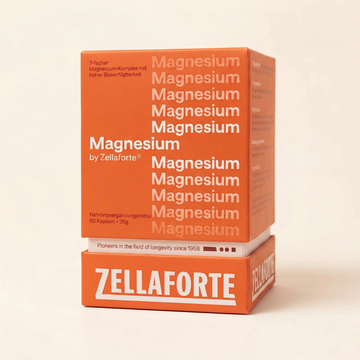
Magnesium
Read the form, not just the label
See how the four tested magnesium forms compare — with the study figures.
To the comparison
Key facts
- Bioavailability is the share of a nutrient that reaches the bloodstream in usable form.
- Magnesium: Sucrosomial® +10.5 % in blood after 24 h, citrate +5.1 %, bisglycinate +4.9 %, oxide +2.4 % (raw material, same dose).¹
- Hydrolysed keratin below 800 Dalton, 500 mg per day: +42 % hair gloss after 90 days.²
- Liposomal resveratrol: 14× plasma level vs. standard extract.³ Quercetin phytosome: 20× absorption.⁴
- All figures describe raw materials, not finished products.
Last reviewed: 2026-09-03 · Zellaforte editorial team
Sources
- Brilli E. et al. (2018): Magnesium bioavailability after administration of sucrosomial® magnesium. Eur Rev Med Pharmacol Sci 22:1843–1851 (PubMed 29630135). Double-blind crossover, 10 healthy subjects, 350 mg elemental magnesium per arm, change from baseline at 24 hours.
- Tursi F. et al. (2025): randomised, double-blind, placebo-controlled trial on hydrolysed keratin (Kera-Diet®), 99 women aged 35–65, 90 days; figures cited are the 500 mg arm. DOI 10.1111/jocd.16626.
- Pharmacokinetic study on liposomal trans-resveratrol (LipoAvail®), manufacturer data, EffePharm.
- Absorption study on quercetin phytosome (Quercefit®), manufacturer data, Indena.
- All studies were carried out on the raw materials, not on the finished Zellaforte products, and do not establish any effect of a food supplement on disease.

